(NEW edits @ the end)
I really like some of the ideas that Levin is playing with in his work. As an overall concept, the idea of making art out of our reactions is a really cool concept. Its like looking in a mirror, and having the mirror wink and wave back at you while you stand there with your mouth hanging open in surprise.
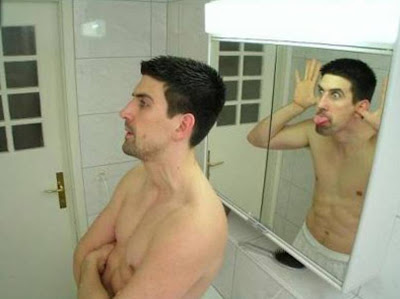
Image From
http://zrooglepic.blogspot.com/2009/01/magic-mirror.htmlI would certainly consider Levins robotic work as art. Even though it relies heavily on computers and robots, there is an artistic element to it. There is no difference in my mind between someone who does interpretive dance, abstract painting, or robotic creations, as long as the end goal is to produce some sort of reaction or response within the viewer. Advertising is designed to make people want to buy stuff. Interpretive dance can show anything from feelings and emotions to the movements of animals and nature (ala Lion King on Broadway - the youtube clips I've seen look amazing.) It doesn't matter what the means are, its all art. Just because he works with computers and robots, I don't consider his work to be any less art then any other more "traditional" types of art.
As a critique of Levins work, I would say that hes succeeded in playing with some cool ideas, but that they're not quite as finished as I'd like them to be. For example, his eye that blinks when you do. I like the idea of a single eye that watches you, and blinks after you do. Its a really subtle, but interesting way of looking at the human body. I'd call it a form of live self-portraiture. What I don't like is the way that his eye is displayed. I know that a lot of computer exhibits I've seen are sort of just placed on a table with a black tablecloth, but thats not good enough anymore. I want to see more then just a black box with an eye in it. I'd want to see it installed in a black wall, floor to ceiling, with just the eye mounted in the center. I mean, the eye is focusing on you, so why not make it easier to focus back on the eye? The other thing I might change is the sound of the eyelid blinking. I couldn't tell from the video if its just the plastic hitting the frame, or what. I assume the noise is there partly so you can tell the eye blinked, but I'd be interested in finding a better/different sound to represent a blink. I'm not really sure how I'd audibly represent a blink. . .maybe hair across a sheet of paper? Maybe a little air piston blowing a puff of air?
I have similar feelings for his second robot. I know that his goal was to try and create a robot that acts like its surprised to see you in gesture, but I'm not sure the googley eye on helps the idea along, or hinders it. In general, the human eye is one of the biggest emotional cues on the human face. I'd love to see his robotic eye from the blinkey-eye modified to fit the surprised robot arm, and have the eye get a mechanical eye lid to squint and stare intently at passers-by.
I'm not sure that the idea of showing surprise through gesture is coming though, or if it just looks like a rather surprised robot arm with a googley-eye covered in a plastic tube. The gestures are good, but I'm not sure the level of finish and finess on the rest of the installation is what I'd expect. Its like the difference between these two :


They're both smiles, but one says a lot more then the other.
I think the surprised robot arm is closer to the yellow smiley. Its a good idea, but its not that refined. I might actually be more impressed with it if I could see that there was a robot arm under that black plastic, and that it was carefully programmed to act surprised. What happens when you overlay the very human idea of surprise onto the skeleton of a machine that supposed to be precision-driven and computer controlled (that should, at least in theory, never be surprised, since it only encounters known conditions)?
I'd want to see the robot arm like this on the smiley scale (if it went from plain yellow/worst smiley to mona lisa/perfection)

Edits/Clarifications/More Stuff
Yellow smiley scale = seemed like a good idea at the time. . . .I think it would be a cool idea if I actually found 10 smileys to create a full scale of "meh" - "AWESOME!!!!"
Thinking a bit while on the train, I got a much clearer idea of what I was thinking about yesterday. There is a robot under that black plastic covering. I'm not sure if I think that the fact that its a robot should be hidden, or exposed and featured as a design aspect of the artwork.
On one hand, having a creature that acts surprised is really cool. But how far do you go making it look like a real creature? Should it have a real eye, and a fancier skin? If you go too fancy and animal-like, do you end up with something that looks like it should have come from Disney world? Is the identity of the robot important, or are the meanings conveyed through the gestures supposed to be the focus of the artwork?
On the other hand, you could just leave the robot exposed. Leave the robot as a robot. Let a mechaical aparatus thats designed to be programed and scheduled have some robotic "fun" and be surprised for a change.